Sunday, 2 February 2014

First Market of 2014 and Candlemas Day

Yesterday was the first Hovingham Market of 2014 it was a busy market but a cold wind was blowing. We went for a spring theme with featuring green as the main colour, next month I think could be blossom inspired!


Today is Candlemas day (2nd February) and in country weather lore the weather today determines how long winter will last.
If Candlemas Day is clear and bright,
winter will have another bite. 
If Candlemas Day brings cloud and rain, 
winter is gone and will not come again.
Unfortunately after some rather wet days its clear, bright and warm today, will winter last another six weeks and will we have a cold snap in March. 


Candlemas dayafter the church is half way between the winter solstice and spring equniox. The 2nd of February used to be the day candles were brought into church and blessed ready for use during services for the rest of the year.Traditionally the evergreens used to dress houses were removed on Candlemas Eve and some say any Christmas decorations left up after twelth night should be removed on Candlemas Day. If you paid your rent quarterly it was due today and servants were sometimes hired on Candlemas Day.

Snowdrops are often called Candlemas Bells they have been flowering for the last fortnight by the river but it is unlucky to bring them into the house before Candlemas Day. I might pick a couple for experimenting with printing, the rest I will admire without picking.

Tuesday, 10 December 2013

Handspinning


Hand Spinning


Hand spinning is the craft of producing yarn from sheep fleece, wool tops or rovings. Many hand spinners use spinning fibres such as alpaca, silk, linen, cotton or even dog and cat hair.
Preparing fibres for hand spinning.
A fleece needs washing before it can be used for hand spinning.  Once the fleece has been washed, the fibres need aligning; this is done by carding. It is easier to produce an even yarn from carded wool. Fleece for hand spinning can be carded on hand carders which produce rolags or a drum carder which produces a batt. 
Hand Spinning
Wool can be spun on a drop spindle or spinning wheel. The drop spindle or spinning wheel puts the twist into the fibre, the spinner drafts the fibre out to create an even yarn. Drop spindles are a good way to start learning hand spinning as they are inexpensive to buy. A spinning wheel is ideal if you are going to do a lot of hand spinning.
Many different yarns can be produced on a spinning wheel, from single to 3 ply, thick bulky to very fine lace weight and loopy boucle yarns to name a few.
Handspun yarns are different to knit with than machine spun yarns because a handspun yarn has different thicknesses in it which adds character to the finished garment. 


Monday, 9 December 2013

One more Christmas Market to go.

It was a busy Hovingham Christmas market on Saturday. I remembered to take a picture this time!
One more Christmas market at Hovingham on Saturday 21st of December from 10.30-1.30.

Friday, 6 December 2013

Christmas Markets

Its feeling really Christmassy here as we get ready for Hovingham Christmas Market on Saturday. We have been busy making draught excluders, perfect for keeping turning old cottages into cosy cottages, cushions for brightening up winter living rooms, Christmas gift bags and tags, needle felted gifts inspired by the North Yorks Moors and much more.

This is the stall from Kirkbymoorside Christmas Market last Saturday.


I have been making a few changes on the website so I have space to add my hand made items, so fancy yarns, carded merino, carded mohair and collage packs have gone. Craft courses have also gone I'm having a break from teaching for awhile so I have time to explore and experiment with new art and craft techniques. Other pages have been amalgamated to make room for my handmade items which are coming soon

Wednesday, 27 November 2013

Its been a really busy couple of months!

The end of summer and early autumn is always a busy time of year for me. The list of jobs seems to be so much longer than the hours to do them! The garden looked fabulous but we weren't in it much!


We had a really busy day at the 10th annual Guisborough Forest Festival, where there were amazing stilt artists.

We had two events on the last weekend in September, my Mother went to Masham Sheep Fair and I went to Yarndale in Skipton. Both were extremely good events for Wheeldale Wolcrafts.

October has flown and here we are at the end of November! Will have to make more effort to write my blog more often.

Monday, 25 November 2013

Natural Dyeing


Natural Dyeing

Introduction
Natural Dyeing is an ancient craft practiced by many different cultures around the world for example the Roman Emperors purple robes and Turkish hand knotted carpets.
In Britain large amounts of cloth were dyed by commercial dyers who used a limited number of dyestuffs, mainly imported, to create a wide range of colours often using techniques such as over dyeing. Smaller amount of cloth and yarn were dyed by women in their cottages either to sell or to clothe their families. Cottage dyers used dyestuffs they gathered in the countryside surrounding them. It is these recipes many natural dyers use today.
All recipes for natural dyes were closely guarded secrets, if you were a commercial dyer your ability to create well dyed, colour fast cloth was your livelihood which you did not want your competitors to be able to copy. Cottage dyers used their skills to provide coloured cloth for their families and the knowledge of local plants and dyeing methods was built up over generations, which enabled women to clothe their families differently from their neighbours.Synthetic coal tar dyes started to be widely use in the late 19th century and enabled dyers to accurately reproduce colours. A wider range of colours and the production of colour fast synthetic dyes led to a decrease in the use of natural dyes.

The Dyestuffs
Many plants, often weeds, growing in our gardens, hedgerows, woodlands and meadows yield a colour. It usually a specific part of a plant such as the leaves, berries, flowers or bark. These plants are easy to find and identify: nettles, dock leaves, blackberries, birch leaves, elder berries, dandelions, and gorse. The following dyestuffs can be found in your local supermarket: onions (just the skins), teabags (can be used ones), coffee (instant or used grounds), walnut shells, turmeric and avocado (just the skins).
If you are collecting plants for natural dyeing you must remember to only collect plants from land you have a right to be on and not to collect any endangered species. For more information click here.
Natural dyeing is a seasonal activity as the parts of plants that yield a dye are often only available at specific times of year such as daffodils in the spring, marigolds in the summer and blackberries in the autumn.

The Mordants
Most natural dyestuffs need a mordant to fix them to the wool. The most common mordant is alum it is a metal salt and it chemically fixes the colour pigments from the dyestuff to the wool. Other mordants are Copper, Chrome, Tin and Tannic Acid. Mordants are poisonous and must be carefully labelled and stored away from pets and children. The easiest and safest mordants to use are alum and iron. Alum is historically the most commonly used mordant and it was extensively quarried and processed on the Yorkshire Coast. Alum fixes most dyestuffs but it can limit the colours attainable. Iron saddens or dulls colours, an easy way of iron mordanting is to put some slightly rusty nails in an old sock in the dyebath.
I use two methods of mordanting, premordanting and the all in one method. Premordanting involves mordating the wool before it is dyed the advantages are you can do one batch of mordanting then dye smaller amounts of wool with different dyes to get a range of colours and once dry the wool can be stored for use later. The disadvantage is you have to heat the wool twice, double the energy use. The all in method is exactly that, mordant and dyestuff in the same pan heated once.

Mordant Recipes.
Premordanting
I have always used imperial measurements, if you are mordanting less than a pound of wool adjust the quantities accordingly.
1lb of wool
4oz of alum for coarse wool/3oz of alum for fine wool
1oz of cream of Tartar (the stuff from the supermarket).
Method.
Weigh out the wool and throughly wet the wool in warm water.
Weigh out the alum and cream of tartar and put them in the dye pan with some hot (not boiling) water to dissolve them.
Fill the dyepan with warm water and add the wool.
Bring to the boil and simmer for 45 minutes.
The all in one method.
Use a teaspoon of alum and half a teaspoon of cream of tartar for every 2oz of wool (dry weight) and make sure it is dissolved before you add it to the dye pan.
How to naturally dye wool.
Natural dyeing is an ancient craft which is both interesting and fun. Anyone with a little knowledge, some basic equipment, dyestuffs and mordants can have a go.
Any equipment used for dyeing must be kept only for natural dyeing and not be used for food preparation. Here is a basic list of equipment:
scales, to weigh wool, mordants and dyestuffs.
a large pan, stainless is best, but enamel or aluminium will do.
pieces of wooden dowel or long handled wooden spoons
a water proof apron and rubber gloves for handling mordants.
a pair of oven gloves and heat proof mat to put the pan on.

If possible do your dyeing outside on a camping gas stove, but where ever you dye make sure it is well ventilated by keeping windows and doors opened.
To get the best results the wool (tops, fleece or yarn) must be free from grease and oils. For information on fleece washing click here. Tops and yarn can have spinning oil in them, it’s easy to remove just soak in warm water with a few drops of washing up liquid in it. As a general rule a equal amount of dyestuff to wool is required (always weigh the wool dry).
Wet the wool thoroughly with warm water, put the dyestuff in the dye bath, add water and wool, bring a simmer and simmer for an hour. This is very general recipe but it gives a good basis for starting to experiment with natural dyeing.
Natural Dyeing at Wheeldale Woolcrafts
Here at Wheeldale Woolcrafts we previously used vegetation from the locality of the North Yorkshire Moors to dye my fleeces and handspun yarns. To achieve brighter colours especially reds and blues we use imported natural dyes. We stock a range mordants, natural dyestuffs, fleece, tops and yarns suitable for natural dyeing. Free recipes are available upon request with my natural dyestuffs.
Workshops focusing on natural dyeing are available on request. We can offer talks and demonstrations on natural dyeing to groups and at events please contact us for details.

A Glossary of Natural Dyeing Terms.
Adjective- a natural dyestuff which requires a mordant.
Substantive- a natural dyestuff which does not need a mordant.
Dyestuff- any plant material which can be used to dye wool
Mordant- a chemical enables the wool to take up the colour of the dye.


Friday, 25 October 2013

A basket woven from an old map.

A couple of months ago I did a soft basketry workshop with Averil Otiv.

We made baskets from old linen backed maps which are stronger than the modern paper versions. Averil had a selection of maps for us to choose from and I chose East Kent as the Joads originate from Canterbury and my brother and I are the first Joads in our line to be born outside Kent. In the early twentieth century there were many Joads in Kent, a significant number emigrated in the interwar period to America. Joad is an unusual name and people have said they thought Steinbeck had made it up for the Grapes of Wrath.
I try to write this blog a couple of times a week, (I know its beeen awhile I'll blame the decorating!) my main aim for the blog is to let people know about new products, events I will be attending and my secondary aim is just to say a bit about what we are doing and what exciting things are happening here. The blog is publicised my website home page, hopefully soon on facebook, and on blogger. Most UK readers use www.wheeldalewoolcrafts.co.uk, the blogger stats show a wide readership in the UK and around the world, but many people read my blog in the USA.  I have often wondered if there are any Joad's in the USA reading my blog if there are   send me a message and say hi.

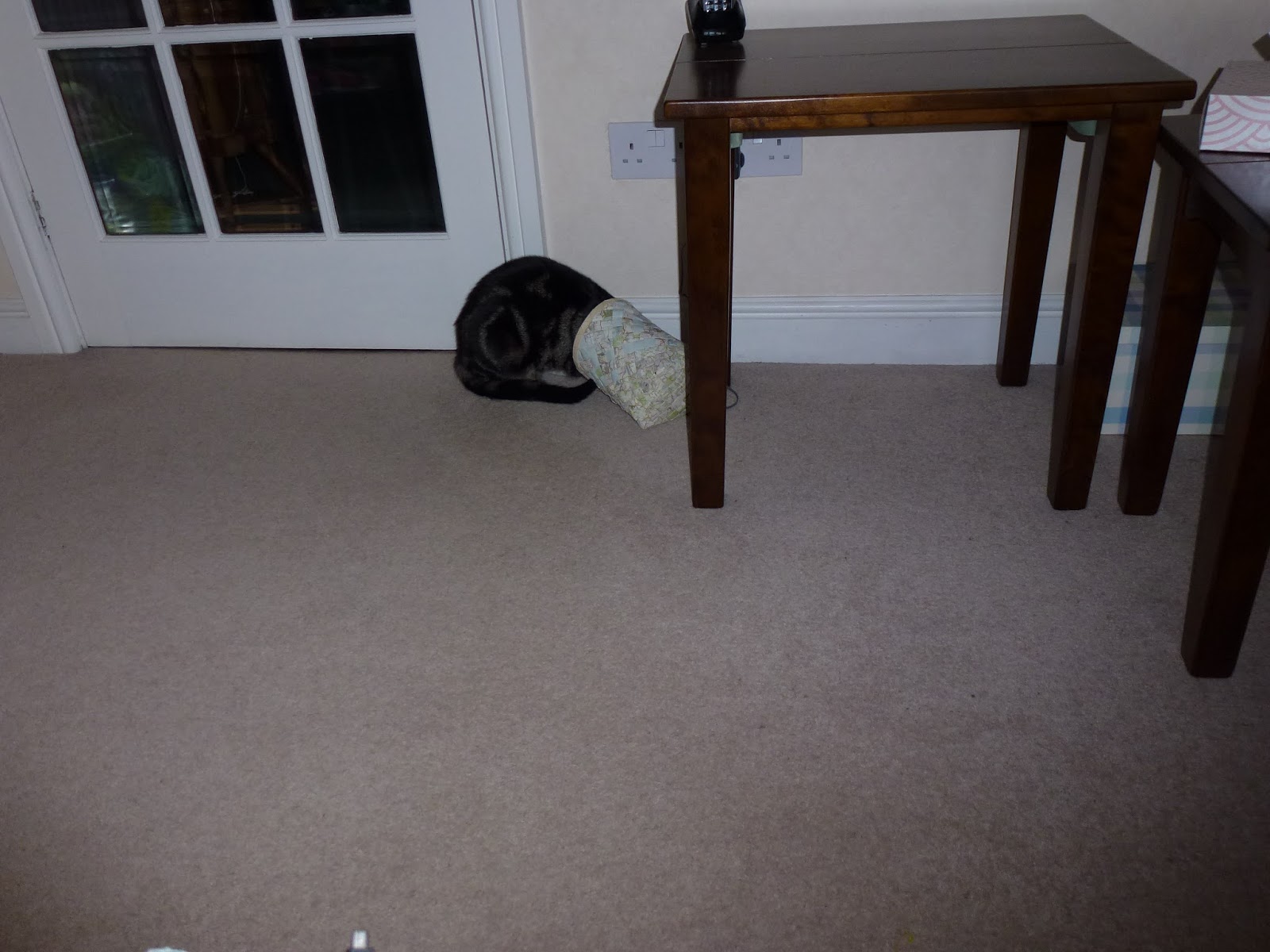
Returning to the basket, I enjoyed weaving it but was rather heavy handed when pulling the strips tight and ended up with the only wonky basket in the group. I will have another go when I have some spare time. Below are some pictures of it and Myrtle loves it.